Monday, 28 March 2016
Updated information on Margaret Richardson
Here is a link to updated information on artist jeweller Margaret Richardson, courtesy of Mr Fernand Haenngi: http://www.art-archives-southafrica.ch/RICHARDSON.htm Excellent update - she was one of the first generation of a smal number of South African fulltime female creative goldsmiths.


Wednesday, 22 January 2014
Information on goldsmith Felix Vetter (late 1930's - 1967/68)
Below is an e-mail exchange with Mr Paul Muser who was acquainted with Mr Felix Vetter. He also provides examples of Vetter jewellery. I hope it would inform readers/viewers about the remarkable work Vetter has produced. Perhaps others who own jewellery made by him would respond and post examples of his work as well?
Fred
(Additional information about Mr Vetter's life and achievements is provided at the end of my posting on Early and mid Twentieth Century South Africa: Legacies of local gold- and silversmiths.)
Fred
(Additional information about Mr Vetter's life and achievements is provided at the end of my posting on Early and mid Twentieth Century South Africa: Legacies of local gold- and silversmiths.)
Date:
November
24, 2013 4:29:10 PM EST
Dear Professor van Staden,
Re: South African Goldsmiths Research Project,
request for information regarding Felix Vetter.
Greetings!
My name is Paul Muser. I was born in 1941. Ever since I can
remember
Felix Vetter was a regular weekly visitor to our home at
80, 6th Avenue Mayfair North Johannesburg until mid 1968 when my Father Gustav, (who was I believe it is fair to say
was Felix's best friend and confidant), passed away.
The following , in no particular order, are my childhood
recollections with respect to Felix. I trust you will find them both interesting and beneficial
to your project.
My earliest strong recollections of Felix are of 1946 during
which Felix would bring large numbers of empty cardboard boxes, along with considerable amounts of foodstuffs; chocolates,
coffee; medications, wool, knitting and sewing materials, cigarettes, writing
materials; clothing, (and other items that a 7 year old would not really be
interested in), which my mother would pack tightly into the cardboard
boxes, then wrap and sew up each box in a sturdy woven material,
(bed sheeting?) , before attaching/sewing on an address/contents label, which I believe carried the International Red Cross
symbol. As I recall the sewn parcels would all be taken to our near
by Post office for delivery to German citizens who I was told were all
suffering too, in the aftermath of the war. There must of been
several hundred parcels that my mother packed and that Felix paid both the cost
of and the shipping for. I thought this was a great humanitarian gesture on Felix's
part.
At that time Felix already had his own Jewellery
manufacturing and showroom Store in downtown Johannesburg. I believe it was on
Jeppe Street?
After the cessation of the Parcel period, Felix would often
stop by our home on his way to and or from work, most often to also unwrap and
show us his latest creations, many of which were in the various manufacturing stages, as
he also had constructed a work shop and bench within his 3rd Avenue Mayfair
North home.
We found these pieces fascinating - not only for their
incredibly complex beauty, but because of the remarkable workmanship. Most of
Felix's jewellery appeared cast at first from various metals, then assembled and
inserted (whilst still warm?) into a deep red hard wax-like substance that wold
firmly hold the pieces onto the end of a sturdy hardwood "dowel" and whilst holding this
attached Dowel in one hand, Felix would literally carve and engrave the metal
using a variety of specially fabricated tools, that Felix had also made especially for the this purpose. Normally Felix would work at his workbench with a leather
apron below the carving/setting area, to catch all of the removed carvings bits
for recasting later, but sometimes,
to illustrate how he produced his masterpieces, he would
proceed to carve or engrave some details, whilst sitting at our kitchen
table!
Felix was a prodigious worker, often working at home until
the wee hours of the morning, all the while smoking and listening to his fine
classical music recordings. All this fine and demanding work required, as one
can imagine, a great deal of strength on Felix's part, which resulted in
Felix having exceptional upper arm/body strength.
One memorable afternoon Felix appeared at our home in high
spirits, with a large brown paper and string wrapped large object under his
arm, saying ""you must haf a look at what I haf.." (in his deep
voice with thick German accent), and hurried to our kitchen table with my
parents and I in close pursuit, whereupon he put down and unwrapped the massive 9 Pound Emerald which he had just purchased from the
Williamson Diamond mine in Tanganyika. A year or so later, Felix brought over a truly magnificent 3
tier Emerald Necklace with matching massive Bracelet and Earrings, all cut from
the Williamson purchase for my mom to wear and pose with. Later he told us he
had sold the set to US individuals reportedly acting for Sophia Loren.
On another occasion, Felix told us that an elderly lady
often came by to look in his window, her peculiarity being that her head bobbed
up and down continuously. One day he intercepted her outside his store and invited her in.
It turned out she was British Royalty, possibly an aunt of Queen Elizabeth? I
cannot recall who she was exactly but I know she had the title "Lady" and subsequently bought a lot
of jewellery from Felix.
On still another occasion, Felix again appeared in very high
spirits with News, brochures and photographs showing he had jus won the Sao
Paulo Biennial, held in Brazil, where he was judged the world's best
Jeweller.
Felix was very kind to me and whenever the situation
allowed, would always enquire as to my welfare/wellbeing and would give me
sage advice regarding ethics and how I should behave and encouragement to
pursue my dreams. On one such occasion, I asked about how he had come to S.
Africa and he said it was by boat and he would never forget his first day. He
had landed at Durban and after clearing Immigration, found himself in this
beautiful warm, ocean paradise, surrounded by roadside vendors who were selling
the most delicious variety of fruits he had ever laid eyes upon, especially
since he had come from europe where I understood he had been hungry and cold
and had not seen fruit for a considerable time, especially the tropical kinds
which he saw in abundance.. As he only had a very small amount of money he
enquired about the price from the vendor, but being unable to communicate, he
finally gave the vendor a silver "tickey (3 pence). The Vendor then gave
him a huge amount of fruit! Felix was both overwhelmed and hungry and determined
that he could not possibly let this fruit go to waste, so he promptly sat down
and proceeded to eat all the fruit throughout the day until early evening when
he started to feel quite ill, then began throwing up as well as developing a
case of diahorrea. Nevertheless after recovering next day he was certain that
he had landed in paradise.
After travelling to Johannesburg as I recall, he rapidly
prospered and within a few years, owned both a car and a thriving business.
However as luck would have it it was wartime, and being of German Descent and
in a British Colony, he was arrested one day and without further adieu, packed
of to an internment camp in South West Africa, where he was held for several
years. True to form however, and ever the entrepreneur/businessman,
he immediately set about making a blow-furnace and new sets of tools, from a
remnant of a car spring for one, he told me, and then began to produce
jewellery in the camp! In answer to my question as to where he managed to
acquire the gold and silver, he explained that he was able to trade for inmates
and guards wedding rings, watch cases, coins, and even gold teeth fillings from
the dentist! He also produced and sold jewellery to the Guards and thus was
able to be on very good terms with them.
In addition, he also employed several inmates to grind and
polish agate and other stones by hand, (mostly in a cabochon shape). It would
take them a considerable amount of time to complete the polishing, but that was
ok as they had plenty of time and there was nothing to do anyway he said with a
laugh.
I'm pleased to tell, I have several of these exquisite
pieces made in the camp!
During a return visit to SA in 1974, I mentioned to his
wife Editha, how much I had always admired his work and asked, if she had
any jewellery Felix had made that she might wish to sell? She replied that she had just assembled the 8 pieces Felix
had made in the camp and had kept for sentimental reasons, and was just about
to send them to the Johannesburg Museum! but would much prefer for me to have
them if I wanted. Naturally I bought them all. Unfortunately 5 pieces
were stolen some years later, but below please see the images of the much
cherished remaining 3, as well as others made by Felix after his release.
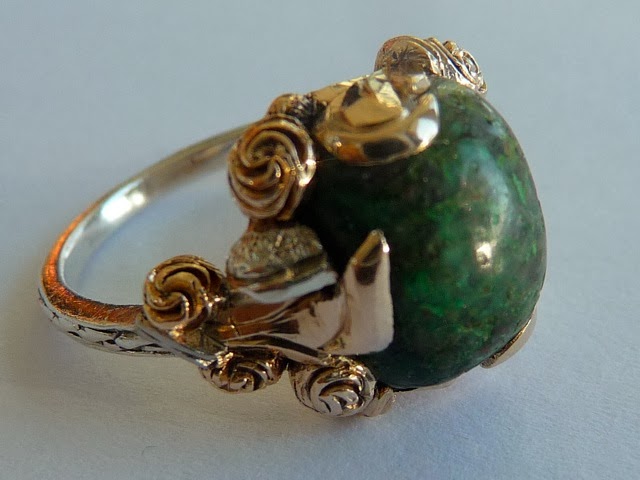

Carved Interior with Felix's stylized FV makers mark clearly
visible
1. This Mostly yellow gold, with Leaf and Roses main
Motif, ornamented with White Gold Engraved shank and 2 side elements, is also
engraved on the inside with Felix's trade-mark "Flower Motif" design. The hand-ground and
polished, mainly Green with fine Maroon mottling/specs Cabochon stone,
appears to be either an agate or a type of Malachite. I has hardly been worn and is
consequently in good condition.


2. This "sister ring, so similar to Ring No. 1
above, is instantly recognizable as Felix Vetter's handiwork during his
Namibian internment camp period. The stone is a beautifully hand polished Agate, mainly cream/grey with
dark Brown and dark Grey mottling throughout. Also signed FV and Engraved
with a more elaborate but similar "Flower Motif" behind, (as also
seen as seen in Ring No. 1.)
IMAGE/S TO FOLLOW
3. Unfortunately this "Internment Camp"
ring, No. 3, also instantly recognizable as Felix's creation. is being
worn by my daughter who is out of the country at this time, so cannot be Photographed. I will send images as soon
as she returns around Christmas 2013
In addition, I also have the following Felix Vetter
creations:

4. This Yellow Gold "Leaf Motif"
with 3 White Gold roses and Ruby set, Tie Pin, (above) Felix gave me for my
21st birthday. 51 years later It is still one of my fondest possessions!


5. Modelled on a Byzantine Poison Ring,
designed to be worn on his little finger, this ring, in yellow and
white gold, was bought by my mother Jutta, for my Father Gustav, as a present for their 25th wedding anniversary. The stone is a Namibian Agate and I suspect, from the workmanship, it
too was made in the internment camp in the 1940's. Like all the other
Namibian pieces, it is engraved with a flower motif on the inside - and signed there, with Felix
Vetter's distinctive engraved FV makers mark. My Father just loved this ring
and wore it whenever the occasion to dress up presented itself. I wore this proudly for many years, but have now
set it aside to give to my son upon the appropriate occasion.
(MAKERS MARK ( a smaller capital F nestled within (but not
touching) a larger capital V. Both letters stylized.
To my knowledge, almost all of Felix Vetter's creations,
from the very earliest produced in Namibia, to his latest in the 1960's, were
signed this way.
In fact it appeared prominently in dark Blue colour, on his
Business Cards; his store signage, as well as a large framed emblem (almost
Coat of arms one could say), hanging in his store.)


6.
This ring, in white Gold, with a beautiful blue sapphire flanked by 3
small diamonds was purchased by my Father for my Mother, as her reciprocal
present for their 25th Wedding anniversary. My mother truly cherished this ring and the memories that
come with it, wearing it well into her 97th year! It, like the Namibian internment camp pieces, also has small engraved
roses at various positions, which add exceptional beauty & charm to so many
of the other creations of Felix's I have seen. In fact I believe it could be stated
that these small, exquisitely executed roses could be considered a trade-mark
of Felix's work, as they appear so frequently on his creations. I often watched as Felix proudly demonstrated how they were carved by
him, out of the metal/s, using specially hardened steel tools he had made,
expressly for that purpose.


7.
This yellow and white Gold ring, featuring an ancient Roman Coin in
place of a jewel, was was another present to Mom, that Dad commissioned from
Felix.

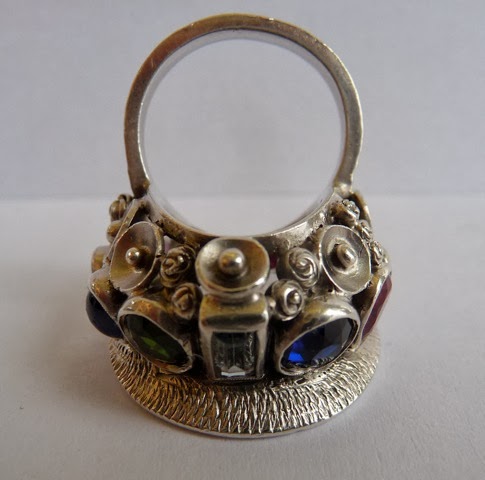


8. This Art Deco style White Gold "dress-ring
Masterpiece, (it might be rhodium plated, but as it is unstamped I do not
know), with inset rectangular vivid Pink Stone(?) set below the angled disk with Diamonds, Ruby, Sapphire,
Emerald and what appears to be a light blue Tourmaline, amidst groups
of Felix's trade mark roses and lilies design, was purchased at first site from Felix one day by my parents. Felix
always referred to at as "the Moon Ring" and so did my Mother.


9. This Yellow & White Gold set with
Emeralds and Diamonds, was originally my Maternal Great Grandmother's
Engagement ring, which she in turn gave to my Maternal Grandmother upon her engagement in the late 1800's. My Grandmother then
gave it to her daughter, (my Mother) upon my Mother's engagement to my
Father in the mid 1920's. After meeting Felix in the mid 1930's or so, My
parents asked Felix to remodel the ring as it was showing signs of considerable
wear by that time. Felix did a most marvellous job, and my mother proudly wore the ring
virtually every day, until early 1993, when, upon being introduced to my wife
to be, immediately took off the ring and handed it to future Daughter-in-law, with
heartfelt blessings and warm wishes, along with her hope that my wife would
continue the tradition, by handing over the ring, when our children would become engaged. One
can just imagine how wonderful the moment was, and what powerful emotions were
engendered. Consequently, just 3 years ago, with the ring showing signs of
significant wear once again, we found a most exceptional Jeweller locally, who
we asked in turn, ( as we really loved Felix's re-incarnation), to refurbish the ring as closely to
Felix's original 1930's remodelling as possible. Now, we have the ring, in it's magnificent condition, safely stored,
awaiting the day when our daughter announces her engagement intentions, so that
we may continue the tradition to the 5th Generation of ring custodians - and - hopefully
with God's blessing, even beyond…..!

10. This 18 Gold cufflink was made & engraved by
Felix Vetter as a replacement for one of my Grandfather's that was lost some 40
plus years previously. It bears no FV signature. but is illustrated simply to
show Felix's wide ranging abilities.
ADDITIONAL ANECDOTES:
I do know that When Felix was released from the South West
Africa Internment camp, upon his return to Johannesburg, He found that his car
had been used to the point where it was unusable, his belongings, workshop,
furniture, dwelling, ransacked and most all of his possessions had disappeared.
Once again he was almost destitute, except for the wonderful pieces he had
diligently made in the Camp, and so he was able to start all over again and
establish himself anew, where by 1947 he was driving a lovely 4 door Silver
Opel Kapitan, then by 1948 or so he was driving a great big Baby Blue Buick
Road-master and even owned a lovely home on Third Avenue in Mayfair
North. One day in 1950 or thereabouts he appeared all excited at
our door to take us all for a drive in his very impressive, shiny new, Black
Jaguar motor car! After he left, my mom told me somewhat breathlessly, that the car had cost as much as a
house did in those days! I was greatly impressed and Felix rose even
further in my esteem as a result.
Later in the mid to late 1950's Felix, with my father as
support, went to Jan Smuts Airport one afternoon to meet a most beautiful,
refined younger Berlin born lady, Editha, whom he subsequently married a
short time after. "Edit" was lovely, physically, and in both mind and
soul. She spent a considerable time with our family who loved her dearly.
Unfortunately there were no children of this union. I think they both
would have loved to have children and would have been great parents.
Felix was also a great cook and would cook up copious
quantities of food at the slightest excuse, to have a party. It is fair to say
Felix really loved life.
Edit and Felix had a Female Ridgeback dog called
"Woezel" that would stare at one - unblinkingly - all the time
that one was in their home! …..It was really quite unnerving! If one turned one's head, Woezel would move around to where
she could lock her golden eyes on on one's own, and just continue to stare -
hard! Otherwise she was a lovely dog.
In the early 60's upon learning I was courting a young lady,
Felix and Edit insisted that we needed to have an appreciation of both Opera
and Classical music, and as such, should attend their beautifully appointed
cultured home, every Thursday evening for an hour or longer classical music
concert, played through their wonderful, state of the art, modern Hi-Fi
equipment. This continued for many months, for which I am forever grateful, as
that love of classical music remains with my family to this day. Just
another example of how kind, generous and thoughtful a human being, Felix
Vetter really was.
In the mid 60's, Felix died of a heart attack one afternoon
in his Jeppe Street store. Some years later, (probably 1975) Edit left SA
to live with her sister in London England.
In the Mid 90's , courtesy of the internet, I came across an
extensive Rosebank auction of Felix's jewellery at very reasonable prices.
Unfortunately I found the site, too late to bid.
If there is anyone reading this who wishes to part with any
of Felix Vetter Jewellery, I would be very interested in being given the
opportunity to purchase it. Please feel free to contact me via e.mail at pmuser@cogeco.ca or by telephone at :
+1 905 338 2087
ADDITIONAL TRIVIA
As mentioned earlier, Felix possessed exceptional strength,
but he once said it was nothing compared to two other men he once knew:
One was the Blacksmith in Pfortzheim or Cologne, (I cannot
recall), where Felix and others were all apprentice Goldsmiths learning their
craft, and who paid regular visits to the local blacksmith. To demonstrate his
strength one day, the blacksmith took one of the horseshoe nails he had
fabricated and whilst the students watched in amazement, he twisted the h nail
into a corkscrew, using only his bare hands!… and taunted the students to do
the same on subsequent visits. Not being able to, and wishing to best the
blacksmith, Felix and his friends made, annealed and hardened a fake
"horse shoe nail", doing their best to make it appear as ordinary as
possible, which they subsequently gave to the blacksmith simply asking him to
make another corkscrew for them…..Upon accepting the Fake and beginning
the first twist, the blacksmith smiled broadly and said…Ah so gentlemen,.. I
see you have learned something at your school after all hey?…
and whilst they watched in astonishment, gritting his teeth but still
smiling, he slowly twisted - by hand - the hardened steel fake into the
corkscrew spiral they had requested, and handed it to them with a flourish!
I immediately visited our local blacksmith to acquire some
horseshoe nails, which Felix generously turned into rings for my friends and I,
which we wore proudly for many years.
The other strong man Felix mentioned was another German who
lived on a huge farm in the then South West Africa, Felix said he could lift a
45 gallon steel drum full of water, from the back of an ox wagon and place it
on the ground, without any assistance! Felix also mentioned that he was also a "real
Character" quite famous in the Windhoek area. For example he had a wife who had nagged him for several
years to take her to one of the functions in Windhoek whenever these social
occasions took place from time to time. On one occasion a large dinner
and dance was also to be coupled with some celebrities appearance and she
really wanted to attend. Ok he said, after much nagging…. "get
yourself ready for this Friday night and we will go. In the meantime I
have to go to Windhoek for some supplies and will be back tomorrow
evening" - Instead he went to Luderitz, boarded a tramp steamer
that was travelling the world and only returned 2 years later!
Some time after the 2nd WW had ended he received a letter from his wealthy family in Germany, informing them that their fortunes had eroded precipitously, and as a consequence, they were no longer able to send him the semi annual stipends he had been receiving for many years.
In response, he had a photographer from Windhoek, make a
special visit to his farm, to photograph him, seated on a large chair,
surrounded by a huge number of scantily clad Herero and other tribes-women,
together with their children, in a large semicircle around him.
He then sent this large photograph back to Germany with a
note stating that as he could no longer afford to live in Namibia without the
stipends, he would have to bring his family home to Germany, and would they
please prepare for his family's arrival as soon as he could make all the
arrangements. Needless to say, the stipends were miraculously found again
in Germany and continued to be sent for many years!
Funny how these stories stick in ones's mind all these many
years. - No?
I consider myself really blessed to have known Felix Vetter.
A true Renaissance Gentleman.
In closing, I trust you will find the above information of
some value and would like to wish you much success with your research
project.
Please do not hesitate to contact me if there is anything
else you feel I might be able to do.
With kindest regards,
Paul Muser


Oakville,
Ontario,
CANADA
e.mail: - pmuser@cogeco.ca
Hi Paul
No, for some reason I have not received the original e-mail. But I am absolutely delighted that you resent it. Thank you very much for your recollections of Felix Vetter – which made him come alive. For me as an academic, this information is worth gold.. I knew little about him, apart from the attached newspaper clippings. But I had a sense that this man was a master craftsman with great creative vision. This is also clear from your images of his work. And the Sao Palo Biennale winner for creative jewellery (have you got an approximate date – I could then follow it up with a newspaper search?) confirms that. Your collection of internment jewellery produced by Felix reflect the time and care that was invested in it. Please take good care of it. Work of this quality produced under internment circumstances is rare, very rare. And beyond its beauty, it also has historical cultural and anthropological significance. His flower motifs are just breathtaking.
I’ll record his maker’s mark in my work.
I would appreciate more information about him: Dates, such when he entered the country, when did he die. I assume, he worked until the day he died – As you have noted, great artists have a compulsion to create and he couldn’t suppress that.
Again, heartfelt thanks for sharing this information. Would you mind if I post it on my blog?
Regards
Fred
I also like the lapel pin – hope you wear it often times.
Felix Vetter, May 1962, Diamond News, p. 63
Diamond News, July 1962, p. 55
Diamond News, April 1963, p.37
From: Paul Muser [mailto:pmuser@cogeco.ca]
Sent: 20 January 2014 09:23 PM
To: Van Staden, Fred
Subject: Re: Felix Vetter 2ND ATTEMPT
Sent: 20 January 2014 09:23 PM
To: Van Staden, Fred
Subject: Re: Felix Vetter 2ND ATTEMPT
Hello
Professor,
So
delighted to learn you finally received the e.mail and images and that you are
pleased therewith.
Thank
you so much for the images which you attached to your reply, I particularly
value the Photo of Felix as I did not have one until now.
As
for your request for additional information, I believe the Sao Paulo Biennial
In which Felix participated would have been in the time period from 1951
(inaugural), 1953, 1955, 1957, 1959, 1961, periods, but I'm sorry I cannot
recall exactly. Their Website is listed in Wikipedia as:- ttp://wwwbienal.org.br
Felix's
Store/Workshop Exterior sign read "F.V Jewellers" in bright blue
outlined letters on a White background. The FV was in the shape of his Makers
Mark. As soon as I have some time, I will determine the exact locations of both
of his retail premises in downtown Johannesburg, for your records.
As
for when he entered S.Africa, Felix was already successful in Johannesburg at
the start of WW2 so I surmise he must have emigrated possibly as much as 5
years prior. I know his port of Landing was Durban.
Felix, collapsed and died of a massive heart attack in his
premises in approximately 1967/1968. I'm sorry I cannot recall the
precise date either.
Also,
professor, my objective was both to respond
to your original request for information, and to hopefully honour Felix by
leaving leave a record of some of Felix's life and works. I think that
Felix would be very pleased to discover he is being memorialized in your
Project/Blog too.
How
wonderful that you took on your interesting and worthwhile project. I am sure
that the families of other Jewellers/Goldsmiths would be greatly honoured by
your fine efforts too.
Bravo
Professor!
With
kindest regards,
Paul
Muser
From: Van Staden, Fred
Sent: 21 January 2014 06:53 AM
To: 'Paul Muser'
Subject: RE: Felix Vetter
Sent: 21 January 2014 06:53 AM
To: 'Paul Muser'
Subject: RE: Felix Vetter
Dear Paul (and please call me Fred),
Thank you for your ‘bravo’, it doesn’t happen often and I feel
flattered..
Also, thank you for good information that I shall include in
future publications. It gives me great satisfaction to record the lives of our
creative jewellers – it is a bit like a Sherlock Holmes process, but every now
and then, someone like you comes along and provide information I could not get
in any other way. I find it exciting.
I have great regard/respect for people who can express ‘wonder
and beauty’ with their hands. I am rather useless in that regard.
Thank you for letting me post your work on my blog. I would like
to post your e-mail as a whole as well as relevant sections of our
correspondence. Must say, the jewellery is very well
photographed. And let’s see, when it is uploaded, perhaps someone else who owns
Vetter jewellery may respond.
Best regards
Fred
Tuesday, 14 January 2014
South African precious metal design between 1960 and 1980
Fred van Staden
(Published in the SA Journal of Cultural History, 29(1), 2015, pp.22-57)
Abstract
This paper comprises a review of the legacies of noted gold- and silversmiths, who opened their studios in South Africa from 1960 to1980.[2] Through literature searches, interviews, relevant e-mail exchanges and internet searches, précis with pertinent information were composed. Information on 14 local gold- and silversmith studios are chronologically presented. Brief notes on a further 8 goldsmiths are also provided. Where possible, descriptions of maker’s marks and the years they were in use are provided.
Key words: Precious
metal artist, goldsmith, silversmith, manufacturing jeweller, maker’s mark,
twentieth century South Africa.
Introduction
Although
small in numbers, the South African silver- and goldsmiths of the mid to late
twentieth century proved themselves on par with their international
counterparts. From 1965 until 1969 and
again in 1974 the South African exhibits at the annual International Arts and
Crafts exhibitions won gold medals and praise.[3]
In 1968 the Director of the Industrial Design Institute
division of the South African Bureau of Standards, Mr Peter Whitworth
(previously employed on the staff of the Council of Industrial Design in the
United Kingdom) attested to the good quality of South African jewellery design
and manufacture, by declaring that:
South
African jewellery can compare with the best in the world.[4]
A few years later Mr.
John Donald, a noted English goldsmith at the time, had this to say about the
quality of South African entries for the 1973 Chamber of Mines Gold Jewellery
Competition:
I was surprised and
delighted by the high standard of the work submitted both in design and
craftsmanship.[5]
Method
Information dealing
with the careers of silver- and goldsmiths who opened their workshops in South
Africa from 1960 to 1980[6]
was gathered by reviewing suitable journals and magazines such as the South
African Panorama, Lantern, Artlook Magazine, The S.A. Jeweller and the Diamond
News, The
Diamond News and The S.A. Watchmaker and Jeweller, as
well as internet searches.
Goldsmiths whose work
was reported in the media during the period of 1960 – 1980 were followed up where
possible with internet searches, e-mail exchanges and interviews. A semi structured interview schedule was used to
compose a summation of relevant aspects of their careers. This included issues
such as their apprenticeships (as well as those they supervised), a
characterisation of their work, important commissions, descriptions of their
maker’s marks, achievements and recognition of their work. Interviews
were also conducted with family members or co-workers to gain corroborating background
information.
The
interviews and all pertinent e-mail exchanges were content analysed and
integrated with available literature. An
initial draft was submitted to a few experienced practitioners for review.
Where warranted, the text was adapted. [7]
Some
noted South African silver- and goldsmith studios established between 1960 and 1980.
Erich
Frey (1961
– 1977)
The work of Erich
Frey and associates Maia Holm (1962 - ), Stephen Colegate (1965 -) and Maurice
Pitol (1981- ) have been extensively discussed in an earlier article.[8]
Abe
Pass (Cape Town, 1963 – early 2010s
)
Abe Pass was born in
Lithuania in 1926, and as a child immigrated with his parents to South Africa.
He completed his apprenticeship as goldsmith with Cooper’s in Cape Town in
1945. To gain further experience he worked with other artist jewellers such as
Doug Saunders and Levitt’s. In 1963 he established his studio in the Groote
Kerk building in Cape Town. He designed individual jewellery items with
precious metals and stones. Since then until 1998, he exhibited his work at
least 15 times at exhibitions in Cape Town and in Johannesburg. In 1967 he
contributed to the gold winning South African exhibition at the International
Arts and Crafts Exhibition in Florence. In 1970 he won a first prize and
commendation at the Intergold jewellery competition. In 1976, he repeated this
performance with a first prize in the section for bracelets and a second prize
in the men’s jewellery section of the competition. In the early 1970’s he also
lectured at Stellenbosch University. [9]
In 1977 his work was
described as
…
of distinguished quality …expressing refinement and a strong aesthetic
sensibility.[10]
He worked on his own
and used an imprint of his name Abe Pass
or only Pass as maker’s mark on his work.[11]

Figure
1: Dress ring encrusted with diamonds, emeralds and garnets by Abe Pass. Valued
between R15 000 to R20 000 in 2010.
(Photo: Strauss &
Co, November 2010 auction catalogue, Cape Town, p. 37)
Sid
Forman (Johannesburg,
1963 – present)
Sid Forman was born in July 1935 in Mayfair,
Johannesburg. At the age of 16 he started his apprenticeship as a diamond
jeweller in the workshop of Cellini’s. After completing his five year
apprenticeship, he worked for another five years with a manufacturing concern
called Ideal Jewellers owned by Mr Morris Adler, after which he worked for Mr Max
Siderski for a while. In 1963 he opened his own workshop in Castle Mansions in
Rissik Street under the name of The House of Sid Forman. The business grew fast
and due to a lack of workspace he moved to a few other premises in Johannesburg
to finally settle in 1996 on the fifth floor of Jewel City in 225 Main Street.
Since 1963 he used a makers mark consisting of the letters S and F inscribed
within the outline of a diamond (or rhombus) shape. A variation where the shape
of a heart is used was introduced by his son David at the turn of the
millennium. Forman works in platinum, 18ct and 9ct white-, yellow- and red
gold. Forman reminisces as follows about his early days of jewellery making:
During the 1950’s the main
expense of jewellery making was the labour and not the materials. Funny how
things have changed.[12]
In 1966 he bought a
casting machine and underwent casting training in Italy. He became one of a
small handful of goldsmiths who casted some of their designs.[13] At the high point of his career he employed
around 120 people in his 1000 square meter workshop. Whereas his jewellery
designs were primarily influenced by Italian trends of the time, it was also
dictated by market demands. Forman is also an accomplished visual artist in the
fields of painting, sketching and sculpting (mostly marble, wrought iron, scrap
metal and gold). Apart from holding one solo sculpting exhibition in Norwood,
he did not commercially pursue his sculpt and paint work, viewing it as a
hobby. He also served for a brief while on the South African Jewellery Council.
Amongst his achievements
was the presentation of an 18cm high ostrich made from 18ct gold that was
presented to President Mandela. He also made a range of figures that included
leopard, elephant, rhino, birds, bushmen, lion, horses and a hunter with his
dog. His high technical skill is especially evident in a small replica of an
antique Chevrolet complete with moving doors, as well as an encased pistol set
in gold.[14] On
evaluating the merits of a jewellery piece he contends that:
First and foremost its
artistic qualities must resonate with the viewer. The artistic qualities of a
piece are expressed in the way that modulation or relief is unpacked in the
design.[15]

Figure
2: A pistol set made of ivory and 18ct yellow and white gold encrusted with
diamonds that took Mr Sid Forman three years to complete. In 2013 the set was
valued at 750 000 US$.
(Photo:
F van Staden, Johannesburg, 21 February 2013)
Since 1973[16]
the House of Sid Forman won a range of awards in jewellery competitions that
included the Chamber of Mines Gold Intergold Jewellery Design competition in
1981[17]
as well as winning the Diamonds Tomorrow Student Design Competition in 1983.[18]
His wife Lorraine and two sons Mark and David hold the distinction of being the
only family who have each in their own right won the coveted Diamonds
International award.
Franz
Huppertz (Cape
Town, 1964 –1997)
Born in 1940 in the
German town of Eshweiler (near Aachen), Franz
Huppertz studied jewellery design (1959 – 1962) at the Kunst und
Werkschule in Pforzheim, West Germany and specialised on the history and
techniques of bracelet making. His training extended beyond silver- and
goldsmithing techniques to a wide range of artistic expression in graphic
design, drawing, painting and sculpting in stone. He studied with Dieter Dill (who later moved to the Western Cape for
awhile) under the tutelage of well known German jewellery master and museum
curator Klaus Ullrich. [19]
Before coming to
South Africa in 1964, he worked in Switzerland where he rebelled against the
strictures of the Goldsmith Guilds and decided to explore Africa. After an
overland sojourn lasting seven months he eventually settled in Cape Town where
he opened his studio called Franz Huppertz Jewellers at the Stuttafords Town
Square in Adderley street.
He exhibited his work
both internationally in Switzerland, Italy and the United States of America and
locally in Cape Town, Durban and Johannesburg. During the 1980s he regularly
exhibited his work in group exhibitions curated under the titles of African Experience (1980), Gold in Fashion (1983 – the collection
was also exhibited in Paris and Milan) and Dreams
of Diamonds (1988). In 1985 he held a successful first solo exhibition at
the Kunskamer Gallery. A unique touch at this exhibition was the design of the
jewellery presentation boxes as wall hangings, allowing the jewellery items to
decorate a wall when not worn. A few
years later in 1989, he staged another solo exhibition titled Art in Jewels at the Town House Museum
in Cape Town. [20]
Huppertz was a
prolific designer and demand for his custom made jewellery grew fast during the
1980’s and he opened a second studio showroom in Cavendish Close, Claremont,
Cape Town.[21]


Figures 3 & 4: Ring drawings by Franz Huppertz as a student in
1961. On the right is a necklace, mask and a brooch in 18carat gold by Franz
Huppertz.
(Photo: Monique
Nienaber, Cape Town, 2012 )
In his designs he
favoured the use of diamonds and gemstones along with creating interchangeable
combination jewellery clusters. He used the lustre, cut, brilliance and emotive
qualities of the stones he selected for his designs, as guidelines for developing
the setting of the design.[22]
Forms, textures and colours in nature as well as cultural motifs often formed
the design bases of his jewellery settings. His work shows a fondness for
granulation along with relief work where different levels are combined or
juxtaposed. [23] He made
only individual jewellery items and as a rule created a number of designs for a
customer to choose the most suitable from. As is the case with a number of
other goldsmiths, he was of the opinion that a reflection of the wearer’s inner
self should be captured by the jewellery that is worn.[24]
Later in his career he diversified the materials he incorporated in his designs
to include mother of pearl, stinkwood, elephant hair, steel and even plastic.[25]
A critic reviewed his use of materials as follows
His art is vested in all
material that has the potential to please. So even in some of his more formal
work, there is surprise and amusement at the audacious use of the
unconventional.[26]
His daughter, a
goldsmith in her own right describes his designs as the
… organic merging of
geometric elements. He designed around the stone and believed that the piece
flows from the qualities and shape of the stone that is used.[27]
As a qualified master
goldsmith, Huppertz was accredited with the Kunst und Werkschule in Pforzheim (Germany)
to offer apprenticeships to their students. He gave regularly of his time as
external examiner for apprenticeship work and students’ jewellery design work. [28]
Between 1970 and 1982
Huppertz won a total of eight awards at various competitions organised by the
Chamber of Mines, Diamonds of Today and Intergold competitions. [29] In 1982 he won the overall Intergold
jewellery design prize with a pair of aquamarine encrusted 18carat gold
earrings, as well as winning entries in the section for men’s jewellery with a
set of cuff links, along with a gold necklace submitted to the section for
ethnic jewellery.[30]
Franz Huppertz
suddenly passed away in 1997 at the age of 57 as the result of a stroke. A few
months before his death, Mr Nicholas Opperheimer presented him with the De
Beers Shining Light Award for Excellence in Diamond Jewellery Design[31]
– a timely testament to a noted goldsmith who helped to extend the range and
interpretive limits of local handmade jewellery.
Hartmut
and Ilse Jäger (Johannesburg, 1965 – 1984)
Of
German parentage, Hartmut Jäger was born in 1940 in Hitler occupied
Czechoslovakia in Eger (now Cheb). After World War II the family returned to West
Germany where he received his initial goldsmith training in Koblenz. He
continued his studies in engraving, setting, making and designing jewellery at
the Art College in Schwaebisch Gmuend.
In
1965, Jäger immigrated to South Africa, working successively for goldsmiths Sid
Forman, then Jack Friedman and for Anthony Sidersky before starting his own
studio in 1969. He became a founding member of the Goldsmiths Guild of South
Africa.[32] At the 1975 Intergold competition he won first
prizes in two pricing categories. In the late 1970’s he partnered with Jochen
Kessel and opened a Jewellery shop in the Bryanston Shopping Center, of which
he and his wife Ilse later became the sole owners.
Jäger
enjoyed working with precious metals and gemstones. His design style was
described as
…’universal’ as it varies with ease according
to mood and circumstances.[33]
In
an article on the role of goldsmiths as artists, Jäger stated the following:
Fine art should have the
quality of taking the observer beyond his or her everyday surroundings to give
them a glimpse of a greater beauty. In jewellery, an individual piece must also
be crafted for the wearer as a unique expression of some quality within that
person. And so the goldsmith is many in one: (s)he is sculptor, designer and
visionary. (S)he must do the setting, engraving and enamelling, and master good
knowledge of the many precious and semi-precious stones as well as the numerous
techniques for shaping and forming of silver and gold. And (s)he must know
people to sense their nature and personalities in order to serve them best.[34]
Austrian
Ilse Meckel was born in 1941 and raised in Ravensburg, Germany. She studied and
obtained a Masters Degree in Jewellery making in Schwaebisch Gmuend, where she
also met Hartmut Jäger . After graduating, Meckel worked for leading workshops
in Helgoland, Geneva and in London. With renowned London jeweller Andrew Grima,
she created the famous Omega watch collection and also designed and made a
brooch for the British Princess Ann. At the invitation of Hartmut Jäger, she immigrated
to South Africa in 1970 to work with him in his jewellery studio. Here she
designed and made a series of barely 2cm high miniature sculpture charms of
animals and people in gold and silver, using the ancient 'lost-wax' moulding
and casting process.
In
1972 Ilse and Hartmut got married. They have two children and in 1984 the
family emigrated to Perth, Australia, where Hartmut Jäger embarked on a new
career as a paintings artist and graphic computer designer.


Figures 5 & 6: A double sided pendant in 18carat gold with rubies and red coral by Hartmut
Jäger and three charms in gold by Ilse Jäger.
(Photos:
From Hartmut Jäger’s résumé.)
During
their time in South Africa, the couple made significant contributions to the local
renewal of jewellery content, design and the combination of different materials
that marked the late 1960’s and the 1970’s. The couple did not make use of
maker’s marks.[35]
Frenchie
Gatticci (Pretoria, 1967 – 1999)
Of Italian extraction,
Hector Francois (Frenchie) Gatticchi was born in 1934 in Nice, France and
immigrated at the age of 13 with his parents who settled in Pretoria in 1947.
In 1952 he started a three year internship in ‘mounting and precious metal
working’ in the Metal Art workshop under Joe Calafato. However, the company
split up in 1953 and Mr Gatticchi completed his internship with a splinter
group called Pretoria Badge and Silver-Smiths Pty. Ltd in Hatfield.[36]
This group consisted of a number of people previously employed by the South
African Mint, namely Mssrs. Becklacke (previous Chairman of the Mint), Percy
Cave (die sinker, well known for a number of maces he produced)[37],
Myburgh and Hendriks (die sinker).This group do not seem to have made use of a maker’s
mark. Gatticchi qualified with a wide range of jewellery making skills (such as
the rolling, soldering and vitreous enameling of precious metals) and he went
back to work for Joe Calafato for a while. In 1967, he and his wife opened
their own studio under the name of Prestige Manufacturing Jewellers.[38] From 1978 until 1980 he and Mr Charl Vorster
(who also apprenticed with Joe Calafato) became partners in the business. After
they dissolved the partnership, Gatticchi moved his studio and showroom to the
Sanlam Arcade, Pretoria City Centre. He focused both on the jewellery making
and retailing market. Amongst his clientele counted a number of government
ministers and officials. He used a P
as maker’s mark on his jewellery until he closed the business in 1999.[39]
Otto
Poulsen (Durban,
early 1960’s )
Otto Poulsen was born
in Denmark and completed a five year apprenticeship in Copenhagen under Willy
Krogmar (a Danish sculptor/goldsmith who became known for his early modernist
designs). The high standard of Poulsen’s apprenticeship work was awarded with a
gold medal by the Danish Guild for Art and Craft work. He worked for a while in
the Georg Jensen workshop. During this time, his development as a designer was
influenced by the designs of Sigvard Bernadotte. The Danish Guild of
Goldsmiths, Silversmiths and Metal Art Workers bestowed a second award on
Poulsen for a bracelet he submitted in an open competition. He also worked with
Henning Koppel, a well known Danish jewellery designer.[40]

Figure 7: A choker by Otto Poulsen consisting of 16
diamonds and 3 Sandawana emeralds[41] set
in 18 and 22 carat gold.
(Photo: Optima,
September 1970, p. 110)
He immigrated to
South Africa in 1955. He worked for a while with Kurt Jobst in Johannesburg who
introduced him to a range of different materials for use in jewellery design.
In the early 1960’s he relocated to Durban where he worked under his own name.
At a later stage his studio amalgamated with that of Robertson’s, a long
established Durban jeweller (since 1910) to form Poulsen Robertson Jewellers.[42]
He worked in gold, silver, precious and semi precious stones embedded in
sculptural designs.[43]
It is clear that this goldsmith was one of our foremost talents in jewellery
making during his time – he worked with the best in the Western world.
Hopefully in future more information about his work will come to light.
Dieter Steglich (Pretoria,
1968 – 2006)
Dieter Steglich was born in 1939 in Berlin. Initially
he qualified as a precision mechanic and worked at Siemens from 1955 to 1958.
He had a natural flair for jewellery making, and as a hobby (without any formal
schooling) he made jewellery pieces for family and friends. Based on a
portfolio of his work, he was accepted for training as goldsmith at the
Staatliche Werkkunst Schule in Berlin, West Germany. After successfully
completing his studies and apprenticeship, he was approached by Erich Frey to
join him at Frey’s studio in Pretoria. The young Dieter grasped the opportunity
with both hands and worked with Frey from 1966 to 1968.
In 1967, Neville
Jones who worked as journeyman for Gilroy King (owner of King’s Jewels),
decided to continue his journeymanship at the Frey studio. Barely a year later, Jones and Steglich left
to open their own studio on 01 April 1968 in Arcadia Galleries in Pretoria.
Their partnership didn’t last and exactly another year later, in 1969, Jones
left to join Heinrich Ocker who owned the Schultis Schwar & Co. jewellery
and watch workshop on Church Square in Pretoria. [44]
For the next 20
years, Steglich continued working in the same premises under his own name D.
Steglich Gold- and Silversmith. Perhaps sensing the increased vulnerability of
jewellery shops to crime that would plague his colleagues in the decades to
follow, he moved his workshop on 01 April 1988 to his home in Meyerspark,
Pretoria. Here he worked with
contentment, stating that at last he has all his tools under one roof. He was a
soft spoken, self contented person, who enjoyed the solitude of his studio. He
avoided crowds but was adept at having individual discussions with his clients
on all matters ranging from philosophy to mechanics. He displayed an
interpersonal sensitivity enabling him to translate aspects of his clients’
personae (or radiance) in his designs. For this reason (and also because of his
accomplished technical ability) he worked mostly on commission and had an
extensive list of loyal clientele. After being bedridden for six months, he
passed away from prostate cancer in October 2006.[45]
His work gave good
expression to the modernist designs of the 1970’s. Due to his initial training
as precision mechanic, Steglich’s work always displayed technical finesse of
the highest order, where spokes, circles, spirals and chains were interlinked
with delicate balance.[46]
He won a first prize in the Chamber of
Mines’ Gold Jewellery Competition in 1970 for the design of personal jewellery
in gold and precious stones.[47]
He also contributed two jewellery pieces to the gold award winning South
African group entry at the Arts and Crafts Fair in Florence in 1974. A total of
46 countries were represented at the fair.[48]
Regarding his
inspiration and design style, Steglich preferred abstract designs that may (or may
not) emerge from organic or naturalist origins. He opined that concentrating
extensively on detail often leads to a weakening of the design as a whole. He
always designed his pieces on paper before translating it into the actual three
dimensional form. He felt strongly that true artist jewelers should not
advertise their work. The work that an artist jeweler creates should sell
itself. Each piece he made, was individually crafted. In addition, he never
made use of waxing methods when creating his jewellery pieces. He included both
precious and semi-precious stones in his designs. He assigned equal status to
stones and their settings, where the design of the setting results in
punctuating the stone as the crown of the setting.[49]
Prof D. van Zyl, a client and friend, reflected as follows on the inspiration
and work of Dieter Steglich:
He
had a high standard of beauty and harmonious composition… Every creation of his
has this blend of outer harmony and inner care, technical precision and human
sensitivity. He always searched for what he called a ‘better idea’, a more
innovative way, which made him a true artist.
He
explored and investigated beyond the boundaries of the everyday, and was open
to the multi-layered mysteries of life in his own inimitable way, soft spoken
and measured, he often shared thoughtful insights and profound understanding of
spiritual matters. He was an artist with matter, and a philosopher in spirit. Above
all, the many times he blended spirit into matter, he unified love with
substance, ultimately made him a creator in the most profound sense of the
word.[50]
Since opening is own studio on 1969, Steglich
made use of the following maker’s marks. The letters ds were used when he worked in gold, an imprint of the
sun was used when he worked in silver and a halfmoon was used when worked with
other metals. The applicable caratage was also stamped on his work. [51]


Figures 8 & 9: Dieter Steglich’s award winning
bracelet in the Chamber of Mines’ Gold Jewellery Competition in 1970. The
bracelet featured five moonstones and 12 rubies in ‘lunar-surface-textured’
gold. On the right is Mr Steglich in his studio in Arcadia, Pretoria in the
early 1970s.
(Photo on the left: F van Staden, Pretoria,
November 2013. The photo on the right is from the Steglich résumé.)
Peter
Cullman (Johannesburg
1967-1977, Toronto 1979-2003)
Peter Cullman was
born in Berlin in 1941 and completed his apprenticeship as goldsmith in
Idar-Oberstein (1956 – 1960) followed by three years of training at the Kunst-
und Werkschule in Pforzheim, Germany. In 1962 he attended a course in gemmology
offered by Erich Frey[52]
who encouraged Cullman to relocate to South Africa. After spending a brief time in Israel, he
immigrated to South Africa in 1963 where he worked in the atelier of Egon
Wegrostek in Johannesburg. In 1966-1967 he travelled to the United States,
Mexico and to Canada where he worked for Walter Schluep, a leading Canadian
avant-garde jeweller. Upon his return in mid-1967 he opened his own workshop in
Fanora House, Johannesburg. [53]
Here he worked until 1977 when he immigrated to Canada where he operated his
own studio in Toronto between 1979 and 2003.[54]
During the twelve
years that Cullman worked in South Africa, his designs were locally lauded by
winning awards at all the Intergold Jewellery Competitions that he entered,
including the overall first prize in 1972 and 1974. In 1969, 1971 and 1974 he
held successful solo exhibitions at Gallery 101 at Rand Central and Gallery 21 in
Hyde Park Corner, Johannesburg. He continued to develop an international
profile by exhibiting some of his creations in 1971 and 1972 at the Inhorgenta
Exhibitions in München. [55]
His work was typified
as flowing organic patterns that reflect elements of nature. In this regard he
proclaimed that
My immediate surroundings
are full of shapes and forms, all of which have an important bearing on my
work. [56]
He worked in silver and gold, with a distinct
preference for gold. His creations were individually designed jewellery items
and as is often found amongst goldsmiths he was attracted to contemporary
sculpture. In many of his works he included stones such as onyx, opals,
emeralds, diamonds along with wood and ivory. [57


Figure 10, 11 & 12: Examples of early work by Peter Cullman. From left to right: A
turquoise matrix cabochon set in 18 carat yellow gold (1976), an 18 carat
yellow gold choker with an ivory and diamond pendant (1972) and an 18 carat
gold brooch set with diamonds and a pearl in the form of a sea urchin (1970).
(Photos: From Peter
Cullman’s résumé as well as Optima, September 1970, p. 110.)
Cullman emigrated in
March 1977 with his family and settled in Canada where he established his own
studio in Yorkville, Toronto in 1978. He continued to work only in 18ct gold or
platinum (as opposed to the Canadian preference for 10ct. or 14ct.). Here his
designs explored an individualistic or idiosyncratic style that did not follow
the design trends of the time. He retired in 2003.[58]
Since he arrived in
South Africa in 1967 until 1973, his jewellery items carried a stamp that
consisted of a capital C placed
within a rectangular frame. Thereafter he made use of the outline of a stylized
‘ring with mounted stone’. Sometimes his surname CULLMAN was added to the ring
mark or used on its own. In Canada he continued using the ring mark. [59]
Tessa
Fleischer
(Broederstroom, 1968 - current)
Tessa Fleischer (née
Loubscher) was born in 1934. After an initial career as film actress she
changed in 1968 to jewellery making under the guidance of husband Michael
Fleischer, a Romanian immigrant metal sculptor. His design philosophy which he
imparted to her, was captured in 1969 as follows
Art
is the truth of the thinking and feeling of its creator – not more, not less
than the plain truth. We do not make art abstract, but it becomes abstract when
this is the way to say only the truth and nothing surrounding the truth which
is not essential to it. The creator develops only the essence which is the truth
and leaves out everything unimportant. The only success for the artist comes
when he has achieved this truth in his work, whether the spectator experiences
it or not.[60]
In 1968 Tessa
Fleischer began exhibiting her jewellery work jointly with the sculptures of her
husband in Johannesburg. [61] In 1970 they again exhibited their work as a
duo at the Pretoria Arts Association.[62]
International exposure came early in her career when she was invited to
participate in the 1974 International Arts and Crafts Fair in Florence, Italy.[63]
During the late 1960’s and 1970’s she was also involved with the organisation
of the annual Living Arts Biennale held in Johannesburg.[64]
Initially she worked
in copper and silver, starting out with jewellery making but soon extended her
repertoire to reliquaries such as chalices, altar candelabra and crosses. This
affinity with spirituality is also expressed in her jewellery designs. Already
in 1969 she stated that her jewellery should convey aspects of the owner’s
inherent persona and should be regarded as
…
essay(s) in spiritual expression.[65]
The materials she
chose to work with were selected for its inherent beauty rather than inherent
value. Apart from precious metals
serving as the base for her work, she made use of tumbled semi-precious stones
and indigenous woods. Her work is often described as spanning the range from
chunky, bold or dramatic to delicate and refined – always conceived with a
sensitive aesthetic. [66]
Early inspiration for her designs was also gleaned from antique jewellery that
she then reinterpreted into modern designs at the time.
An important
commission came her way in 1985 when the Anglican congregation of St Mary’s in
Johannesburg requested her to design and make the ceremonial staff and pectoral
cross for the inauguration of Bishop Desmond Tutu. It consists of tambotie
wood, sterling silver, amethysts, tourmalines and garnets.[67]


Figures
13 & 14 : Left is Tessa Fleischer with Bishop Tutu’s inaugural rosier made
from Tambotie wood and sterling silver. On the right is a copper, brass and onyx
choker by Fleischer.
(Photos: The Star
newspaper, 01 February 1985, p. 12, and SA Panorama, July 1974, p. 20.)
From her work it is
clear that much attention has been paid to detail, to the extent of creating
individually designed chains that extend and accentuate the inspiration
expressed in her pendants, necklaces, bracelets or girdles.[68]
Her husband’s African themed work shows a synergy with her work that was
influenced by various trips in Africa. She is regarded as a creative and an
imaginative jeweller with a career spanning over 40 years.[69]
Since 1974 Fleischer
worked from her studio-gallery at home in Broederstroom that she shared with
her husband until his passing in 1991. Her work in copper is marked with a
flower pattern that is underscored by the name FLEISCHER in a half circle. She
marked her work in silver with the words KUNSTGEWERBE FLEISCHER arranged in a
circle around the outline of a bird. Underneath, the acronym HAN. ARB appears.
Though some variation occurred over the years, all her work contained at least
the imprint of her surname.[70]
Uwe
Koetter Jewellers
(Cape
Town, 1968 - )
Uwe Koetter was born
in 1937 in Hamburg, Germany where he studied and completed his apprenticeship
as goldsmith in 1957. Part of his training also included classes in pottery,
enameling, silk printing, engraving, copper work and drawing. Early recognition
of his promise as goldsmith came in 1958 when he was awarded the Hamburg
Chamber of Commerce prize for his examination piece at the age of 20. This led
to an invitation to relocate to (the then) South-West Africa to work as
goldsmith in Windhoek, which he did. But the market was small and a year later
he immigrated to Cape Town. Here he further honed his jewellery making skills
by working for other jewelers until 1968, when he opened his own workshop with
the support of his South African wife, in the Colonial Mutual Building.[71]
Already in 1973 he
was regarded as a notable creative goldsmith in the country.[72]
He staged a number of solo exhibitions of his work in Cape Town. The
exhibitions were extensive and each contained around 300 individual items of
jewellery. The ability to create such extensive ranges of jewellery for his
exhibitions is a strong testament to his prolific creativity.[73]
Koetter was
commissioned by the de Beer’s Company to set the Eureka Diamond for presentation
to the country’s inclusive democratic parliament at its first sitting in 1994.
This was the diamond that set off the Kimberley Diamond rush in 1876, and the
Oppenheimer family decided to present it to parliament.[74]
. He works mainly in
18 carat gold, finding it more refined and malleable to work with since it
contain much less silver than 9 carat gold. His handcrafted designs were
summarised as follows:
He exploits the versatility
of gold in every possible way and combines it very successfully
with tourmalines, garnets, rubies and
emeralds.[75]

Figure 15: An 18 carat gold ring embellished with ruffled cubes, diamonds and emeralds by Uwe Koetter. Valued between R15 000 to R20 000 in 2010.
(Photo: Strauss & Co, November 2010
auction catalogue, Cape Town, p. 37.)
Koetter was trained
in a traditional design style that was rooted in a post World War II European
ethos. Much attention was paid to detail and skilled craftsmanship that
required intensive and diverse training. In the early 1970s he reflected that a
new design style was emerging. Precision was exchanged for emphasis on texture,
colour and contrast in abstracted forms. He stated that
…
the resulting trend in jewellery is casual, almost unfinished and there is no
place for precision… it is a reflection of living conditions and, as such
cannot be fought … this trend will continue until there is some form of social
revolution[76]….
Designs are becoming more classical and tailored.[77]
Baroque foliage and
tendrils have made place for combinations of lines and circles in
deconstructred form. In the mid1970s Koetter also noted an increased preference
by clients for jewellery designed around a collection of small diamonds
(sometimes combined with other precious or semi-precious stones) as opposed to
making use of a single prominent solitaire stone. This is likely to have
resulted from a concerted and successful campaign by De Beers to extend it’s
market to middle class homes due to an increasing haul of small flawless
diamonds [78]
In 1980 his
brother-in-law Johan Louw joined the workshop as co-designer. He had a Bachelor
degree in Fine Arts, majoring in gemmology and geology. Louw contributed to the
studio’s accumulation of design awards by winning prizes in the Intergold (2nd
prize in 1982), De Beers Diamonds Today (2nd prize 1985, 1st
prize in 1993), the Jewellery Council Creative awards (1st and 2nd
prize 1993), the Shining Light Award competition for Excellence in Diamond
Jewellery Design (two 1st prizes, 1997) and Riches of Africa (Overall
winning entry, 2003) competitions. [79]
In 1995 the workshop
was commissioned by the Government to design and make a brooch as a gift for
Queen Elizabeth during her tour of the country. Louw designed the piece in the
form of a peacock–flare symbolizing the dawn of a new era. It consisted of an
art-deco style channel set baguette diamonds with a triangular diamond in the
centre, set in white gold. An 18 carat gold horizon reflects the image from an
old one rand note. Behind this the South African sun rises with a flair,
consisting of the colours of the South African flag as captured with South
African diamonds, tourmalines, onyx and gold.[80]


Figures
16 & 17 : Designed by Johan Louw, this commemorative brooch was presented
to Queen Elizabeth II by Nelson Mandela at Tuynhuis in 1995. Contemporary and
classic lines were combined to express the dawn of a new era. Yellow and white
gold encrusted with local gemstones were used. On the bottom, Queen Elizabeth II
is wearing the gift in the presence of the then Deputy president Thabo Mbeki,
his wife Zanele Mbeki and the Duke of Edinburgh during her state visit in 1995.
(Photo: From Johan
Louw’s résumé, e-mail, 22 November 2013)
The workshop is
presently employing a number of goldsmiths, gemologists and graders. They make
all forms of jewellery in precious metals and stones, ranging from neck jewellery
items to earrings to bracelets to rings. They make use of the letters U and K where the right leg of the U is merged with the vertical leg of
the K.[81]
Kurt Donau (Johannesburg, 1969 – 2008; Chur, Switzerland, 2008 - )
Kurt
Donau was born in 1935 in Switzerland where he received his training as goldsmith.
He worked for various workshops in Chur, Geneve and in Zurich but his wanderlust drew his attention to Africa.
Since the South African government at the time limited the number of goldsmiths
who entered the country he applied for an initial working visa as ‘watch casing
maker‘ and promptly settled in Johannesburg in 1957 with
Egon Guenther’s workshop[82]
as a qualified jeweller.[83]
Here he gained valuable experience for three years. True to the European
tradition of extending one’s skills base by working at a number of establishments before settling down, he then
worked for Jack Friedman for seven years where he was given a free hand to
contribute to the design portfolio of the Friedman workshop. In 1969 he took
over Egon Guenther’s business and established his own workshop named Kurt Donau
Jewellery along with his maker’s mark consisting of the letters k and d (expressed in bold, lower case).[84]
From the start his
work articulated an African flair in
both design content and the materials he used. His designs were often inspired
by the African animal world, from which he extracted an innate aesthetic in the
composition of shape, line and form – a design process to which his classical
training greatly contributes. He made liberal use of South African precious and
semi-precious stones along with other mediums such as coral, sodalite, ivory,
leather and woods such as stinkwood.[85]
As opposed to the European preference at the time for jewellery designs in
white gold, he enjoyed working with yellow gold, which is a traditional South
African preference as well. His work is handmade and does not contain any
machine made components. He views machine made jewellery as soulless.[86] In 1979, a critic described his work as
...
most fascinating, especially in terms of flamboyance and sheer weight of gold.[87]
As part of his
commitment to his new fatherland, Donau became involved in the local
development of the profession and industry. He offered apprenticeships to
aspiring goldsmiths, such as John Skotnes who set up the Jewellery Department
at the Cape Peninsula Technikon. He also collaborated with a number of other
South African fine artists such as Edoardo Villa, Hannes Harrs and Cecil
Skotnes where he made jewellery items based on the artists designs. [88]

Figure 18: Gold and Platinum cufflinks, designed by Cecil
Skotnes and made by Kurt Donau sold in 2012 at the Stephan Welz & Co.
auction in Johannesburg for R9 500.
[89]
(Photo: Stephan Welz catalogue, April 2012,
Johannesburg, p. 196)
In 1974 he was a
founding member of the Goldsmiths Guild of South Africa – the first serious
attempt to organise and develop the fraternity of local creative goldsmiths
(this is also an indication of the fledgling nature of the profession during
the early part of the twentieth century, even up to the mid 1970s it still only
consisted of a loose grouping of individual gold- and silversmiths). [90]
As indication of his good standing
amongst his contemporaries, Donau was regularly requested to serve as judge in
a range of national jewellery competitions (1997 – 2005).

Figures
19, 20 & 21: Examples of 18 carat gold rings by Kurt Donau with Sandanawa
emeralds, diamonds and ivory dyed in red.
(Photo: S. Donau,
Chur, Switzerland, 2011.)
After suffering a
hi-jacking and a robbery[91],
at the age of 73 Kurt Donau returned with his family to re-settle in Chur, Switzerland
in 2008 where he continues to design and create precious metal jewellery and
objets d’art.[92]
Michael
Cope (Cape Town, 1972 - current )
Michael Cope was born
in Cape Town in 1952, and in 1971 he started his apprenticeship as jewellery
designer and goldsmith under the tutelage of Franz Huppertz. In 1973 he worked
for E. Plaut as a jewellery designer, but soon his creative spirit found
expression in his own studio, which he opened in 1974 in Cape Town. Since then
he has taken part in numerous one-person and group exhibitions in Cape Town and
Johannesburg, as well as exhibitions in his own studio. In 1979 at the opening
of a solo exhibition in the Cape Gallery, Cecil Skotnes referred to Mike Cope
as an innovator displaying great originality and technical skill.[93]
In 1980, at an exhibition in Johannesburg, Cope’s work was described as mainly
figurative with a ribbed or ripple texture that results from making use of
cuttle fish bone when casting his work.[94]
In 1982 he designed
and implemented a formal jewellery training programme at the Royal Crown
Jewellers in Maseru, Lesotho.[95]
In 2012 a retrospective exhibition of his work was curated by John Skotnes (goldsmith
and son of Cecil Skotnes) at the Irma Stern Museum.[96]

Figure 22: A collection of early work by Mike Cope.
(Photos: M. Cope, Cape Town.)
His initial work was
influenced by the Scandinavian design tradition of the late 1960s and early
1970s.
Cope himself typifies
his work as
… sculptural, often
narrative with references to the periods when sculptural metalwork was most
prominent in jewellery – renaissance, baroque, Arts & Crafts – though there
is a modernist thread as well.[97]
He works in gold and
silver, often mixing the two metals in sculptured jewellery items. He makes use
of a capital letter M encircled by a
C that is joined to the right bottom
leg of the M as maker’s mark on his designs. He is also an accomplished poet
and novelist.
Ewald and Liz Kratz (Johannesburg, 1974 – 1986, Brisbane, 1997 - present )
Ewald Kratz was born
in Pforzheim, a town in the Black Forest that has long been a centre of German
jewellery design and training. He followed in the footsteps of a 300 year old
family tradition and completed his apprenticeship as goldsmith at the Kunst und
Werkschule in Pforzheim. Subsequently, in 1965, he relocated to South Africa.
Shortly hereafter he married South African Elizabeth Bezuidenhout, who just
completed her studies in jewellery design at the University of Stellenbosch. In
the early 1970’s both husband and wife worked for Jack Friedman in Johannesburg
before they opened their own studio called Studio
K in 1974. In 1973 they already showed early signs of their creative design
styles by winning the Chamber of Mines Gold Jewellery Competition with an18
carat gold a necklace-choker-bracelet-buckle combination piece set with
diamonds and black onyx.[98]
They produced
individual work but often also collaborated. As a design team they were well
suited in the sense that Ewald’s romantic flowing lines served as counterpoint
to Liz’ bold and expressive approach to design. This collaboration was
internationally recognised when they won the prestigious Diamond International
Award in 1977. This was only the second time that the award was won by South
African based goldsmiths. [99]
Their participation in a number of local competitions such as the Intergold
Jewellery Design contests also yielded awards in their own individual rights as
goldsmiths.[100] In
addition, they took part in the innovative 1979 and 1983 Intergold exhibitions,
where the creations of local goldsmiths and local couturiers were paired.[101]
At the time, Ewald Kratz’ work was described as … (a) delicate line(s),
refined, light and ethereal in places , whilst his wife’s work was depicted
as having … a more everyday look about it, incorporating ivory and plastic –
decidedly up to date and unusual.[102]
In 1981, a gold
necklace by Ewald Kratz was crowned as overall winner of the Intergold
jewellery design competition.[103]
In 1982, Liz Kratz won the bracelet section of the Intergold competition with a
broad bracelet (in red, yellow and white gold) depicting the Khoi-San
creationist belief that a tree gave birth to all animals and humans who lived
in harmony with each other until fire was discovered.[104]
In 1985, their work
was selected by Intergold in collaboration with an international fashion research
bureau as representative of international fashion styles at the time.[105]
During the late 1970s to early 1980s they employed a number of other award
winning goldsmiths such as David Tranter and Natalie Slominsky. [106]
In 1986, the Kratz
family resettled in Pforzheim where Ewald Kratz finalised his training as a
master goldsmith. Apart from graduating in Jewellery Design and Manufacture,
Liz Kratz continued to study widely in related disciplines that include Metallurgy,
Geology and Gemmology.
Years later, the
family migrated to Brisbane Australia, where they opened a new studio under the
name of Kratz Exclusive Jewellery in 1997. Their jewellery has featured
internationally in all the main fashion centres of the world, including Milan,
Paris, London, New York, Basle and Tokyo.[107]

Figure 23: The Diamond International award winning entry
in 1977 by Liz and Ewald Kratz, consisting of 18 carat gold, diamonds and
beads.
(Photo:
L. Kratz, Brisbane, Australia)
During the time of
running their studio in South Africa between 1974 and 1986 they used a maker’s
stamp consisting of the name of the business studio K. During these years they also used a mark consisting of
the letters E and K superimposed on each other. A third mark that is still in
use today consists of two overlapping 90degree triangles giving the impression
of a bow tie.
The years that Ewald
and Liz Kratz spent in South Africa provided them with an initial platform of
recognition for their work that was to be continued and celebrated elsewhere in
the world.[108]
Daniel Jacobs (Stellenbosch, 1980 - current)
Born in Namibia,
Daniel Jacobs was raised on a farm. He trained as jeweller at the University of
Stellenbosch, and following his award winning entry in the 1978 ‘Diamonds
Tomorrow’ competition, he was offered a position as designer goldsmith with
Frowein Jewellers in Stellenbosch. Within months though, he was drafted for a
two year period of military service. Upon his return in 1980, Frowein Jewellers
sold their workshop operating as Stellenbosch Manufacturing Jewellers (Pty)
Ltd. to Jacobs as a running concern. In 1983, he changed the name of the
workshop to Goldart. In this same
year, Jacobs designed and patented a multi purpose pearl
clasp allowing the ‘mix and match’ combination of different strings of
pearls, beads or necklaces.[109]
In 1990 he received from amongst 2000 participants, three of the seven possible
awards for his exhibits at the Jewellery and Watch Trade Fair in Hong Kong. He
was the first entrant ever to receive more than one award.
Fellow designer
Gerhardt Nel joined him in 1989 at his Goldart studio in Pleinstreet,
Stellenbosch. In 1993 they formed a joint venture with the French company
LabarteParis SA, and became the first South African goldsmith studio to
contribute to the design and making of ranges for international jewellery
houses such as Cartier. [110]
However, their
collaboration didn’t last and in 1994 the partners broke up and Jacobs opened
his new studio under the name Daniel
Jacobs Jewellery Design in Paradyskloof. He won the 2006 PlatAfrica
competition sponsored by Anglo Platinum to stimulate and grow the demand for
platinum jewellery. Other entries of his, were also selected as finalist submissions
in 2006 and 2007.
Jacobs describes his
designs as nature inspired with a simplicity of line that affords a modernist
quality to his work. At times though he also gain his inspiration from the
materials (be it stone or metal) that he is working with.[111] In
terms of jewellery design, he often makes use of the golden ratio or golden
proportion into his designs as aesthetic guideline. In this way, he
believes that pleasing harmonious lines and dimensions can be achieved in
jewellery design.[112]
Like his contemporaries, his early work reflects an extension of the use of
line, relief and texture that came to the fore in the early 1970s.


Figures
24, 25 & 26: From left to right:
Makers marks used by Daniël Jacobs. A diamond and 18 carat gold ring that won
the 1977 overall award at the Diamonds International competition. An 18 carat
gold and sterling silver landscape design bracelet.
(Images from the
Jacobs résumé.)
From 1980 until the
formation of Goldart in 1983 Jacobs used the stamp SMJ (Stellenbosch
Manufacturing Jewellers). Since then, he used an abstracted form of the letters
G and A where the larger right leaning G is fused to a smaller left leaning A.
Jacobs also used the stamp DAJ on some individual jewellery items. From
1994 he introduced as maker’s mark a stylized butterfly with four segmented
wings have been used (originally to symbolize the freedom of having embarked on
a studio on his own). The butterfly wing mark is used on a signature line
consisting of individualized pieces. [113]
Brief references to
other gold- and silversmiths of the time
A number of other
goldsmiths whose names and work are mentioned in the literature, deserve
mentioning. Though little more than brief citations exist, it appears that each
in their own way contributed to a South African legacy of precious metal
artistry:
Jochen
Kessel was born and trained in Pforzheim, Germany and
relocated to South Africa in 1969. He distinguished himself as one of the
country’s top designers by winning 12 Intergold jewellery awards between 1971 and
1976, along with four international awards and a gold medal at the Inhorgenta
exhibition in Munich.[114]
He already became a noted goldsmith in South Africa early on in his career.[115]
He took part in the 1979 and 1983 Intergold exhibitions, where the creations of
local goldsmiths and couturiers were paired.[116]
In 1985, his work was presented by Intergold as illustrative of current
international fashion expressions.[117]
His work is described as analytical rather than intuitive, making use of
refined geometric shapes.[118]
In 1979 his work was described as using forms in an imaginative and
unconventional way with a strong emphasis on colour.[119]
He is thought to have immigrated in the
late 1980s to Brighton, England.[120]
Guy
Traest was born
and trained in Belgium, where he obtained diplomas in carpet- and jewellery
design. He arrived in South Africa from the Congo in 1967 and opened his own
studio in 1974. Initially, he expressed a preference for using ivory as base
medium in his work. He regarded ivory as a versatile material that blends well
with other stones, metals and organic materials. He has twinned ivory with
diamonds, coral, emeralds, gold, lapis lazuli and even buffalo horn. In the mid
1970s some of his work was exported to the United States, Paris and Amsterdam. [121]
He won a number of Intergold awards. He took part in the 1979 Intergold
exhibition, where the creations of local goldsmiths and couturiers were paired.[122]
In 1985, his work was also selected by Intergold in collaboration with an
international fashion research bureau as representative of contemporary
international fashion expressions at the time.[123]
His style is refined, expressing an elegant touch with a penchant for combining
white, red and yellow gold.[124]
In 1979 his work was typified as keeping to a straight forward line.[125]
He made use of the maker’s marks guyRS as well as two stylistic capital
letter Gs where the second G is turned around to become the mirror image of the
first G.[126]

Figure 27: A Choker, necklace and ring in sterling silver
combined with ivory and stones from Madagascar by Guy Traest.
(Photo: S. Botha, 2013)
Michael
Fleming was born in 1947 in the then South West
Africa. The abundance of semi-precious stones found in this country stimulated
his interest in creating settings that would extend the beauty or captivating
qualities of the stones. After a two year art school course in silversmithing
and more than two years of practical work under a qualified goldsmith, he left
for Germany and perfected his craft by training for ten years as goldsmith in Pforzheim.
During this period, he spent much time studying ancient techniques in jewellery
making, and became an admirer of Italian Renaissance artist Benvenuto Cellini.
In 1959 he moved to South Africa where he opened a small workshop in Pretoria.
Here his sister Gabi Hagg did an apprenticeship under him.[127]
His designs were well construed and executed. He made use of gold, silver,
gemstones and varied other materials such as ivory and wood. He also enjoyed
making use of colourful glowing enameling in his designs. His work also
included enamelling. In 1975 Flemming proclaimed that his ambition was to
create a design style … with definite
shape and lots of movement.[128]
South African born
goldsmith Gordon Watson did an internship under Flemming during the early 1970s.[129]
In 1974 both Watson and Fleming submitted work to the gold award winning South
African exhibition at the 38th Art and Crafts Fair in Florence,
Italy.[130]
Dieter
Dill studied with Franz Huppertz at the Kunst und
Werkschule, Pforzheim Höhere Fachschule in West Germany during the early
1950’s. He became a lecturer in jewellery design at the University of Stellenbosch
during the late 1970s and 1980s. In 1975 his work was described as a
reinterpretaion of brutal 20th century icons such as the traffic
light, zebra road crossings, the vacuum cleaner and electrical pumps. Dill
explored anti-classical elements in his designs such as large monumental
looking pendants with simple lines or brooches expressing non-symmetric
compositions. Notwithstanding the boldness of his work, the subtle use of
texture and colour also gave it a graphic elegance that extended beyond
the traditional boundaries of artist
jewellery of the time.[131]
He repeatedly won a number of prizes in jewellery competitions, that included
first prizes in the Chamber of Mines Intergold Jewellery Competition in 1973,[132]
1976,[133] 1981[134]
and 1982.[135] He
also partook in the 1983 Intergold exhibition at the Chamber of Mines Pavilion
at the Rand Show where couture dresses were matched with his gold jewellery.[136]
He was recognized as a noted goldsmith in South Africa.[137]
Gunther
Knauer was situated in Durban and sponsored Neville
Clipson and Michael Sand who won first and second prizes in the Diamonds
Tomorrow Student Design Competition in 1982.[138]
German born Marianne
Vossgütter (née Fisscher) completed in 1968 a degree in
precious metal design at the University of Stellenbosch. For two years she
worked for another goldsmith in Cape Town to gain experience before she opened
her first studio under her nickname Lali, also in Cape Town. Late in
1970 she relocated to Johannesburg where she re-opened her studio in Rosebank. In
1971 she won the Chamber of Mines First Prize in jewellery design (with a pair
of golden earrings set with moonstones). This served as a promising indicator
of her aesthetic perceptiveness and excellent craftsmanship. In 1971 she stated
that although I find it tremendous fun to make the popular and incidental
jewellery, I prefer to create carefully thought out, highly individual pieces.[139]
Whereas her early
work was done in gold and silver, she concentrated exclusively on silver
jewellery since 1974, finding the medium more ‘free’ to work with.[140]
She incorporated pearls and semi-precious gemstones in her work, and designed
her own hand beaten chains and bracelets. She maintains that her work is not
commercially motivated and that this is reflected by her individually crafted pieces.
One critic described her work as bold and singular.[141]
Polish born Henrietta and Ziegmunt Glogier immigrated
to South Africa in 1967. They set up a workshop in Randburg, Johannesburg. They
specialised in hand made silver jewellery, making use of semi-precious stones or
pearls as accentuating nodes in their designs. Their work was described as
strikingly simple, combining contemporary design with an antique look.[142]
Goldsmith
maker’s marks that appear regularly on local antique
and collectors markets include the stamps WWL
and PJ on well made sterling mounting
silver settings for Southern African semi-precious gemstones. Their simple art
deco designs seem to stem from the 1970’s. The mark BJL also occurs on cultural icons such as brooches consisting of a
baroque writing of the Afrikaans word Moeder.
Two other marks that appear at times on
the local antique markets are Zeeta and Oblo. Only two photo
references for these marks could be obtained. Mr. W. Z. Ungar was photographed
showing a range of Zeeta marked chains at the Trade Fair in 1979,[143]
and Mr. M. Oboler was photographed in front of his studio in Cape Town that
bore the name Oblo Jewellers.[144]


Figure
28, 29 & 30: On top is an onyx,
sterling silver and marcasite bracelet carrying the Oblo maker’s mark. Notable
is the use of marcasite that was rarely used by South African creative jewelers
in the 20th century.in the middle is a Zeeta marked 9 carat gold and garnet
brooch. Below is a sterling silver bracelet with semi-precious stones bearing
the mark WLL.
(Photos: F van Staden, Pretoria, 23 November 2013.)
Concluding
comments
The 1960s and 1970s
was a time of renewal and change that was not only reflected in painting and
sculpture. Synergistically, it was also expressed in jewellery design. In a new
design trend, small diamonds became more liberally used in. In another
transformation, creative goldsmiths began to incorporate semi-precious stones
in their work and experimented with metals other than silver, gold or platinum.
Organic material such as ivory and wood were incorporated in some designs.
During this era, the
palette for jewellery making expanded enormously. It was a time of discovery
and the congruent presentation of new combinations of impressions, along with
the simplification of line. More than ever before, the middle class could afford
good quality individually forged jewellery items.[145]
[1] Hierdie artikel volg op ‘n oorsig
van die werk van plaaslike goud- en silversmede tydens die eerste helfte van
die twintigste eeu in Suid-Afrika. Dit is vervat in Legacies of immigrant gold- and silversmiths during
early and mid-twentieth century South Africa, South African
Journal of Cultural History, pp 139-164, Junie 2013. Ook, An overview of
noted gold- and silversmiths in South Africa in the 1950s, South African Journal of Cultural History, in druk, Junie 2014.
[2] This article follows on a review of the work of local gold- and silversmiths
during the first half of the century. See Legacies of immigrant gold- and silversmiths during
early and mid-twentieth century South Africa, South African
Journal of Cultural History, pp 139-164, June 2013. Also, An overview of noted gold- and silversmiths in
South Africa in the 1950’s, South African Journal of
Cultural History, in print, June 2014.
[5] Author unknown, High standards at gold jewellery competition,
The S.A. Jeweller and the Diamond News,
April 1973, p. 31. Also, author unknown, All that glitters here really is gold,
South African Digest, 06 April 1973, clipping from the art archives,
University of Pretoria.
[6] Because of space limitations, it was decided to limit
the review to the period 1960 to 1980 only. Also, the period from 1980 to 2000
covers a phase of significant socio-organisational change that will require a
review in its own right.
[7] Reviewers were Messrs. Vic Thomson and Charles Kgosana
(engravers, Pretoria), D Schilofsky (jeweller, gemologist, Pretoria) and F.
Haenggi (art dealer, Basel, Switzerland).
[8] F.van Staden, Erich Frey and Associates: A bold
contribution to South African silver- and goldsmith design, South African Journal of Cultural History,
June 2011, vol. 25(1), pp. 148-179.
[9] Abe Pass – home page, http://www.abepass.com/indexs.htm, 2009-09-25. Also, author
unknown, Goue Sierade, Panorama, June
1970, p. 25. Also, author unknown, Kaapse goudsmede presteer, Die Burger, 04
May 1976 (clipping from the art archives, University of Pretoria).
[10] E Mesman, Kuns in Kaapstad, Die
Burger, 06 May 1977, clipping from the Art archives, University of
Pretoria. The original Afrikaans quote is as follows: … van ‘n hoogstaande
kwaliteit … toon ‘n verfyning en ‘n sterk estetiese sin.
[13] Other goldsmiths and workshops who made use of casting
included Joe Calafato (1912-1991), Metal Art
(1951-present), Simba (1954-late 1970’s), Mauro Pagliari (1957 – present) and
Mari Lou (late 1950’s – early 1970’s).
[16] Author unknown, High standards at gold jewellery competition,
The S.A. Jeweller and the Diamond News,
April 1973, pp. 30, 31 & 33.
[17] M. Neri, Creativity within wearability, Diamond
News and S.A. Jeweller,
July 1981, pp. 3, 14 & 16. Also see A.Weil, Intergold encourages
innovation, Diamond News and S.A. Jeweller, September 1981, p. 15. Also, a photo
clipping from Die Transvaler, 15 June 1981, p. 9 (clipping from the art
archives, University of Pretoria).
[18] C. Hacker, Students present fresh ideas in De Beers
jewellery contest, The S.A. Jeweller and the
Diamond News, January 1983, p. 2.
[19] Huppertz studied in Pforzheim under professors
Schollmeyer, Ullrich and Reiling. Source: Personal files from the Huppertz portfolio.
[20] Author unknown, Huppertz spreads his wings
to décor, Diamond News and S.A. Jeweller,
April 1985, p. 17.
[21] Personal documentation from the Huppertz portfolio
that includes an undated newspaper clipping with the heading Invitation to Franz Huppertz champagne
celebration.
[22] Telephonic interview: F.van Staden – M. Huppertz,
goldsmith and daughter of F. Huppertz, Cape Town, 26 July 2012.
[23] Author unknown, Timeless gold keeps pace
with the latest fashions, Diamond News
and S.A. Jeweller, September 1981, pp. 25 & 27.
[24] Author unknown, Diamonds Today 1979, Diamond News and S.A. Jeweller, May 1979,
pp 3 and 5, as well as author unknown, Diamonds Today 1979: Highly commended, Diamond News and S.A. Jeweller, June
1979, pp. 45 and 47. Also from Huppertz personal portfolio: Clip from the De
Beer’s Dream of Diamonds Yearbook,
1988, p.8.
[25] Author unknown, Huppertz spreads his wings
to décor, Diamond News and S.A. Jeweller,
April 1985, p. 17. Also, a cutting from the De Beer’s Dream of Diamonds Yearbook, 1988, p.8 from Huppertz personal portfolio.
[27] Telephonic interview: F.van Staden – M. Huppertz,
goldsmith and daughter of F. Huppertz, Cape Town, 26 July 2012. Huppertz personal portfolio: Cutting from
the De Beer’s Dream of Diamonds Yearbook,
1988, pp. 8-11.
[28] After an initial four year apprenticeship with a
qualified master goldsmith, a period of working as a journeyman follows. Those
who want to become master goldsmiths were then required to complete a second
two year apprenticeship in the workshop of different master goldsmith before
being accepted as a master goldsmith.
Telephonic interview: F.van Staden – M. Huppertz, goldsmith and daughter
of F. Huppertz, Cape Town, 26 July 2012. Also, personal documentation from the
Huppertz portfolio that includes an undated newspaper clipping with the heading
Invitation to Franz Huppertz champagne
celebration.
[29] M. Neri, Creativity within wearability, Diamond
News and S.A. Jeweller,
July 1981, pp. 3 & 16. Also see A.Weil, Intergold encourages innovation, Diamond
News and S.A. Jeweller, September
1981, p. 15.
[30] E. Moolman, Dra Boesmans se legende aan jou
arm, Beeld, 09 June 1982, p. 11.
[31] Personal files from the Huppertz portfolio. Also, telephonic
interview: F.van Staden – M. Nienaber, goldsmith and daughter of F. Huppertz,
Cape Town, 26 July 2012.
[33] Author unknown, Gold Gleanings, Diamond News and S.A. Jeweller, November
1979, pp. 13 and 42. See also unknown author, Timeless gold keeps pace with the
latest fashions, Diamond News and S.A.
Jeweller, September 1981, pp. 25 & 27.
[35] E-mail, H Jäger-F van Staden, Ilse, Hartmut and the SA Goldsmiths Guild,
13 December 2012. Also, e-mail, H Jäger-F van Staden, 3rd lot of pictures from Hartmut, 15 December 2012
and e-mail, H Jäger-F van Staden, A few more answers, 17 December 2012. E-mail, L. Kratz-F. van
Staden, Re: Goldsmiths: E & L Kratz,
14 August, 2012.
[36] Apprenticeship contract of H.F. Gatticchi , signed on
29 August 1953 and termination on 07 April 1955. From Mr Gattichi’s résumé.
[37] D. van Pletzen, Mace Maker: All in a day’s work, South African Panorama, February 1973, pp.
45-46.
[38] Author not stated, Prestige Jewellers:
Streng eerlikheid en top gehalte werk, Pretoria,
Caxton Ltd., Johannesburg, circa 1977, p. 307.
[39] Interview: Mr H.F.
Gatticchi, Pretoria, 2009-09-12.
[40] J. Prangnell, Kuns en
goud, Suid-Afrikaanse Panorama, April
1963, p. 40.
[41] Sandawana emeralds are of the
rarest and most perfect emaeralds in the world and is mined in Matabele land in
Zimbabwe.
[42] Poulsen Robertson, http://www.otto-poulson.co.za, 2011-12-04. Efforts to obtain
more information on both the Otto Poulsen and Robertson legacy from the present
owners were unsuccessful.
[44] G. S. Geyer, Die goudsmid, sy kunswerk en plek
in die samelewing, unpublished research report in Art History III,
University of Pretoria Art Archives, undated (possibly the early 1970s).
[45] Interview with Gisela Steglich and Sonja,
wife and daughter of Mr D Steglich, Meyerspark, Pretoria, 08 November 2013.
Also see the Family eulogy, In honour of Dieter Steglich, 15 October
2006, from the Steglich family résumé. Steglich was a genius in solving
mechanical problems and could fix any break down caused by mass manufacture or
cheap engineering with innovative solutions. Like many creative goldsmiths, he
detested mass manufactured goods. He had a great love for his 1959 Volkswagen
Beetle that he fitted with a Porsche engine and maintained in spotless
condition throughout his life.
[46] Personal photo albums from the Steglich
Résumé, 08 November, Meyerspark, Pretoria, 08 November 2013.
[47] Author unknown, S.A. wins gold, ARTLOOK, May 1974, p.28. Also, author unknown, Goue Sierade, Panorama, June 1970, p. 24.
[48] Author unknown, Ons beste goud en
silwer…, undated newspaper clipping, Art archives, University of Pretoria.
[49] G. S. Geyer, Die
goudsmid, sy kunswerk en plek in die samelewing, unpublished research
report in Art History III, University of Pretoria Art Archives, undated
(possibly early 1970s).
[51] G. S. Geyer, Die
goudsmid, sy kunswerk en plek in die samelewing, unpublished research
report in Art History III, University of Pretoria Art Archives, undated
(possibly early 1970s).
[52] At the time Frey took a sabbatical and was
teaching for a year before finally immigrating to South Africa in 1964.
[55] J Ambrose-Brown, Jewellery in South African Art, Macdonald, Cape Town, 1978, p.50. Also, author
unknown, Goue Sierade, Panorama, June
1970, pp. 24 & 25. Also, author unknown, Jeweller’s art, Sunday Express,
17 November 1974, clipping from the art archives, University of Pretoria.
[56] E. Frank, Peter Cullman, Artlook, September 1971, p. 33. Erich Frey, a contemporary of
Cullman, was also emphatic in his conviction that designers are inevitably
influenced by the surrounding worlds in which they live.
[58] E-mail correspondence: P. Cullman – F. van Staden, Goldsmiths Guild et al, 2012-07-12, as
well as Re: Goldsmiths Guild, et al,
2012-07-14.
[59] E. Frank, Peter Cullman, Artlook, September 1971, pp. 32-33. H Peter Cullman, http; www.art-archives-southafrica.ch/CULLMAN.htm, accessed 2012-06-12. Also,
e-mail correspondence: P. Cullman – F. van Staden, Goldsmiths Guild et al, 2012-07-12.
[60] M. Fleischer, Michael Fleischer,
Artlook, October 1969, p. 33. Michael Fleischer came to South Africa in
1963 as sculptor on a large government commission. Another notable commission
was his design for the opening of the Hugenote tunnel in the Cape in 1989.
Additional references: Author unknown, Michael Fleischer – Metal Sculptor, ART LOOK, November 1968, p. 5; R.
Cutler, Architectural sculpture, Style
Magazine, June 1983, pp. 90-94; B. Davitz, Groot projekte op Michael se
kerfstok, Die Transvaler, Januarie
03, 1989, p. 12.
[61] Author unknown, Juwele uit afvalstukke, Die
Tranvaler, 04 December 1968 (clipping from the art archives, University
of Pretoria).
[62] Untitled clipping from the Pretoria News,
dated 11 September 1970, from the art archives, University of Pretoria.
[67] K. O’Reilly, Local artist creates symbolic staff for
Tutu’s inauguration, The Star,
February 1, 1985, p.12.
[68] Author unknown, S.A. wins gold, ARTLOOK, May 1974, p.28. Also, see J. Kotze, Presents of mind and
spirit at art gallery, Pretoria News, 21 October 1974. Clipping from the
Art Archives, University of Pretoria.
[69] R. Cheales, Sculptures show a family affair, THE CITIZEN, March 28, 1987, p.19. Also, A. Cremer, The Artful farm, SA Country Life, January 1996, pp. 26 –
31.
[71] Author unknown, Personalities in the
diamond trade, The Diamond News and
S.A.Jeweller, April 1977, p.5. Also, U. Koetter, Curriculum Vitae, from the
Koetter résumé. Also, author unknown, ‘n Meester met goud, Die Landbou
Weekblad, 26 May 1970, pp. 71 and 88.
[72]L.Dellatola, Jewellery Council,
South African Panorama,, December
1973, p. 1.
[73] Author unknown, Master ‘Midas’ , The
Argus, 25 April 1972, p.27. Also, unnamed photograph with caption on a charity solo
exhibition by Uwe Koetter, The Argus,
1972-04-29, p. 6. Also, M. Levitt, Koetter stages elegant display, The
Diamond News and S.A. Jeweller, December 1979, p.22, as well as M. Levitt, New jewels at
Koetter display, The Diamond News and S.A. Jeweller, November
1980, pp.3 & 49. Also, G. Cooper, Gertrude Cooper’s People
Page, Cape Times, 29 September 1979, from the Koetter résumé.
[75] M. Levitt, New jewels at Koetter display, The
Diamond News and S.A. Jeweller, November 1980, p. 49.
[76] Undated (possibly early 1970s) newspaper clippings, Juwele se musiek
bekoor steeds, and Real craftsmanship not necessary but -, from the
Koetter résumé.
[78] Undated, Juwele se musiek bekoor steeds,
and Real craftsmanship not necessary but -, from the Koetter résumé.
Also, author unknown, ‘n Meester met goud, Die Landbouweekblad, 26 May
1970, pp. 71 and 88. Also, author unknown, Exciting combination of gemstones, The
Jewish Herald, 24 July 1979, from the Koetter résumé. Also, E. du Toit, Ringe vir aldag
en eendag, Die landbouweekblad, 3 November 1978, p.115.
[79] An undated newspaper clipping
titled Win for Jeweller, from
the Koetter résumé. Also, Uwe Koetter Flash, October 1997, from the
Koetter résumé. Aziz Hartley, Designers show their golden touch, Cape Times,
25 July 2003, p. 7.
[80] E-mail: J. Louw – F. van
Staden, Uwe Koetter history,
2009-01-10. Also, E. Moolman, Dra Boesmans se legende aan jou arm, Beeld, 09
June 1982, p. 11. P. Diamond, Johan Louw designs jewel for the queen, Diamond
News and S.A. Jeweller, May 1995, p.13.
[82] F.van Staden, An overview of
noted gold- and silversmiths in South Africa in the 1950’s, South African Journal of Cultural History, June 2014, pp. 139-163.
[83] Eberhard Dechow,
Arbeiten aus Südafrika, Goldschmiede
Zeitung, 1970, vol.68(4), p. 417.
[84] Riches of Africa More than 100 enter Gold Jewellery
Design Competition, AngloGold Ashanti, http:www.anglogoldashanti.co.za/Additional/Press/AngloGold/1998/10+Dec+1998, 2009-09-27. Also, e-mail correspondence: K. Donau – F. van Staden, Kurt Donau, 2012-02-01.
[86] D. Schöbi, Ein Rheintaler
Goldschmiedt kreiert Schmuck für Königinnen, Unser Reintal, 31 October
2011, pp. 1-3.
[87] Author unknown, Linking gold, threads, The
Star, 13 November 1979. Clipping from the Art Archives, University of
Pretoria.
[88] J.A. Brown, Jewellery, South African Art, Macdonald South Africa, Cape Town, 1978. Also, http://donau-handcrafted-jewellery.ch/About.html, accessed 2012-01-05, as well
as John Skotnes TED profile, http:www.ted.com/profiles/bio/id/305081,
2009-09-27.
[89] Author unknown, Catalogue one: session five, item 921,
Stephan Welz and Co., Johannesburg, 24-26 April 2012, p.
196.
[91] Since the dawn of democracy in the early
1990’s, increased attacks on jewellers and their workshops has played its role
on increased security expenses as well as the emigration of qualified goldsmiths.
Another outflow is reflected in the development of a culture where women do not
easily display their jewellery publically anymore, for fear of being robbed.
[94] Author unknown, Juwele uit die
Kaap, Beeld, 22 Februry 1980, clipping from the art archives, University
of Pretoria.
[98] Author unknown, High standards at gold jewellery competition,
The S.A. Jeweller and the Diamond News,
April 1973, pp. 30, 31 & 33.
[99] Author unknown, Gold Gleanings, Diamond News and S.A. Jeweller, November
1979, pp. 13 and 42. Also, author
unknown,
Timeless gold keeps pace with the latest fashions, Diamond News and S.A. Jeweller, September 1981, pp. 25 & 27.
[100] M. Neri, Creativity within wearability, Diamond
News and S.A. Jeweller,
July 1981, pp. 3, 13 & 14. Also see A.Weil, Intergold encourages
innovation, Diamond News and S.A. Jeweller, September 1981, p. 15.
[101] A. Weil, Gold Gleanings, Diamond News and S.A. Jeweller, January
1980, pp. 10, 11 & 13. Also, author unknown, Gold in fashion, Diamond News and S.A.Jeweller, March 1983, pp. 29-31. Also, author
unknown, Goud in die mode, Suid-Afrikaanse
Panorama, Julie 1983, pp. 48-50.
[102] Author unknown, Linking gold, threads, The
Star, 13 November 1979. Clipping from the Art Archives, University of
Pretoria.
[103] A photo clipping from Die Transvaler, 15
June 1981, p. 9, (from the Art Archives, University of Pretoria).
[104] E. Moolman, Dra Boesmans se legende aan jou
arm, Beeld, 09 June 1982, p. 11. The winning piece was designed
by Liz Kratz and made by her husband Ewald Kratz along with colleague David
Tranter.
[105] Author unknown, Capturing jewellery
fashions for 1985, Diamond News and S.A.
Jeweller, March 1984, pp. 23-25.
[106] Author unknown, Diamonds Today 1979, Diamond News and S.A. Jeweller, May
1979, p. 5. Author unknown, Diamonds Today – 1979 Highly Commended, Diamond News and S.A. Jeweller, June
1979, p. 45. A. Weil, Huppertz triumphs at Intergold Jewellery design competition,
Diamond News and S.A. Jeweller, July
1982, p. 3.
[107] E-mail correspondence: P. Cullman – F. van Staden, Goldsmiths Guild et al, 2012-07-12.
Also, www.kratzjewellery.com.au, accessed on 2012-07-16.
[110] Author unknown, French partner for Goldart,
Distrikspos, 10 December 1993. E-mail, re Daniel Jacobs geskiedenis, 2013-12-01.
[112] D. Jacobs, Keynote address, Jewellex Exhibition, Sandton Convention Centre, Johannesburg,
02 September 2013. The golden ratio occurs when the ratio of two measurements
is the same as the ratio of their sum is to the larger of the two measurements.
The golden ratio is expressed in mathematics as the irrational or infinite
number 1.618033… and is denoted with the
Greek letter phi. It is held by some artists and architects that aesthetically
pleasing proportions are attained when their work incorporate approximations of
the golden ratio.
[113] E-mail, Re: Daniel Jacobs Jewellery Design,
2009-10-20. Follow-up e-mail, re Daniel Jacobs geskiedenis, 2013-12-01.
[114] E. Phillips, They are creating beauty in metal, newspaper
clipping (courtesy of Hartmut Jäger), 1975. Also, author unknown, Kunstenaars
se juwele sal harte steel, Die Burger, 29 April 1980, clipping from the
Art Archives, University of Pretoria.
[116] A. Weil, Gold Gleanings, Diamond News and S.A. Jeweller, January
1980, pp. 10, 11 & 13. Also, author unknown, Gold in fashion, Diamond News and S.A.Jeweller, March 1983, pp. 29-31. Also, author
unknown, Goud in die mode, Suid-Afrikaanse
Panorama, Julie 1983, pp. 48-50.
[117] Author unknown, Capturing jewellery
fashions for 1985, Diamond News and S.A.
Jeweller, March 1984, pp. 23-25.
[118] Author unknown, Gold Gleanings, Diamond News and S.A. Jeweller, November
1979, pp. 13 and 42. See also A. Weil, Huppertz triumphs at Intergold Jewellery
design competition, Diamond News and S.A.
Jeweller, July 1982, p. 11, as well as unknown author, Timeless gold keeps pace
with the latest fashions, Diamond News
and S.A. Jeweller, September 1981, pp. 25 & 27.
[119] Author unknown, Linking gold, threads, The
Star, 13 November 1979. Clipping from the Art Archives, University of
Pretoria.
[120] E-mail, L. Kratz-F. van
Staden, Re: Goldsmiths: E & L Kratz,
14 August, 2012.
[121] Author unknown, Hy toor met ivoor, Die
Transvaler, in the Klaradyn/mode section, 2 November 1977. Clipping
from the Art Archives, University of Pretoria.
[123] Author unknown, Capturing jewellery
fashions for 1985, Diamond News and S.A.
Jeweller, March 1984, pp. 23-25.
[125] Author unknown, Linking gold, threads, The
Star, 13 November 1979. Clipping from the Art Archives, University of
Pretoria.
[126] E-Mail, S. Botha , Guy Traest
identifisering, 18 August 2013.
[128] Author unknown, Golden stylist, SA
Digest, 21 February 1975. Clipping from the Art Archives, University of
Pretoria.
[130] Author unknown, Ons beste goud en silwer…,
unreferenced newspaper clipping, Art Archives, University of Pretoria, 1974.
[131] Author unknown,
Juweliersware op Worcester, Kuns en Vermaak section, Die Burger, 20 June 1975, p. 13.
[132] Author unknown, High standards at gold jewellery competition,
The S.A. Jeweller and the Diamond News,
April 1973, pp. 30, 31 & 33.
[133] Author unknown, Kaapse goudsmede presteer, Die
Burger, 04 May 1976 (clipping from the art archives, University of
Pretoria).
[134] M. Neri, Creativity within wearability, Diamond
News and S.A. Jeweller,
July 1981, pp. 3, 15 & 20. Also see A.Weil, Intergold encourages
innovation, Diamond News and S.A. Jeweller, September 1981, p. 15.
[135] A. Weil, Huppertz triumphs at Intergold
Jewellery design competition, Diamond
News and S.A. Jeweller, July 1982, pp. 3,11 and 13. Also, E. Moolman, Dra
Boesmans se legende aan jou arm, Beeld, 09 June 1982, p. 11.
[136] Author unknown, Gold in fashion, Diamond News and S.A.Jeweller,
March 1983, pp. 29-31. Also, author unknown, Goud in die mode, Suid-Afrikaanse Panorama, Julie 1983, pp.
48-50.
[138] C. Hacker, Students present fresh ideas in De Beers
jewellery contest, The S.A. Jeweller and
the Diamond News, January 1983, p. 2.
[139] Author unknown, Lali works in silver and
gold, The Star, 19 October 1971 (clipping from the Art Archives,
University of Pretoria).
[144] Author unknown, Trade Fair 1979, Diamond News and S.A. Jeweller, August
1979, p. 39. Also, Mike Oboler was a ‘manufacturing
jeweller’ from Cape Town, who contributed to the continuing hallmarking debate
at the time and was quoted as being strongly in favour of a instituting a
national hallmarking system: We need a
system with a quick turn-around time, non-destructive testing, recognition of
special conditions (for example small manufacturers) and with standards that
are internationally acceptable. Also, see J Hobbs, SA hallmarking – one step nearer, Diamond News and S.A.Jeweller, December
1984, p. 32.
[145] Author unknown, Modern Jeweller, Artlook,
No. 37, December 1969, pp. 21-22. Also, see author unknown, No time-lag
in setting the watch fashion pace.., Rand Daily Mail, 10 May 1971,
clipping from the Art Archives, University of Pretoria. Author unknown, Elegant en ‘n
bietjie gewaag, die Transvaler, 06 July 1971, clipping from the Art Archives, University of Pretoria.
Subscribe to:
Posts (Atom)